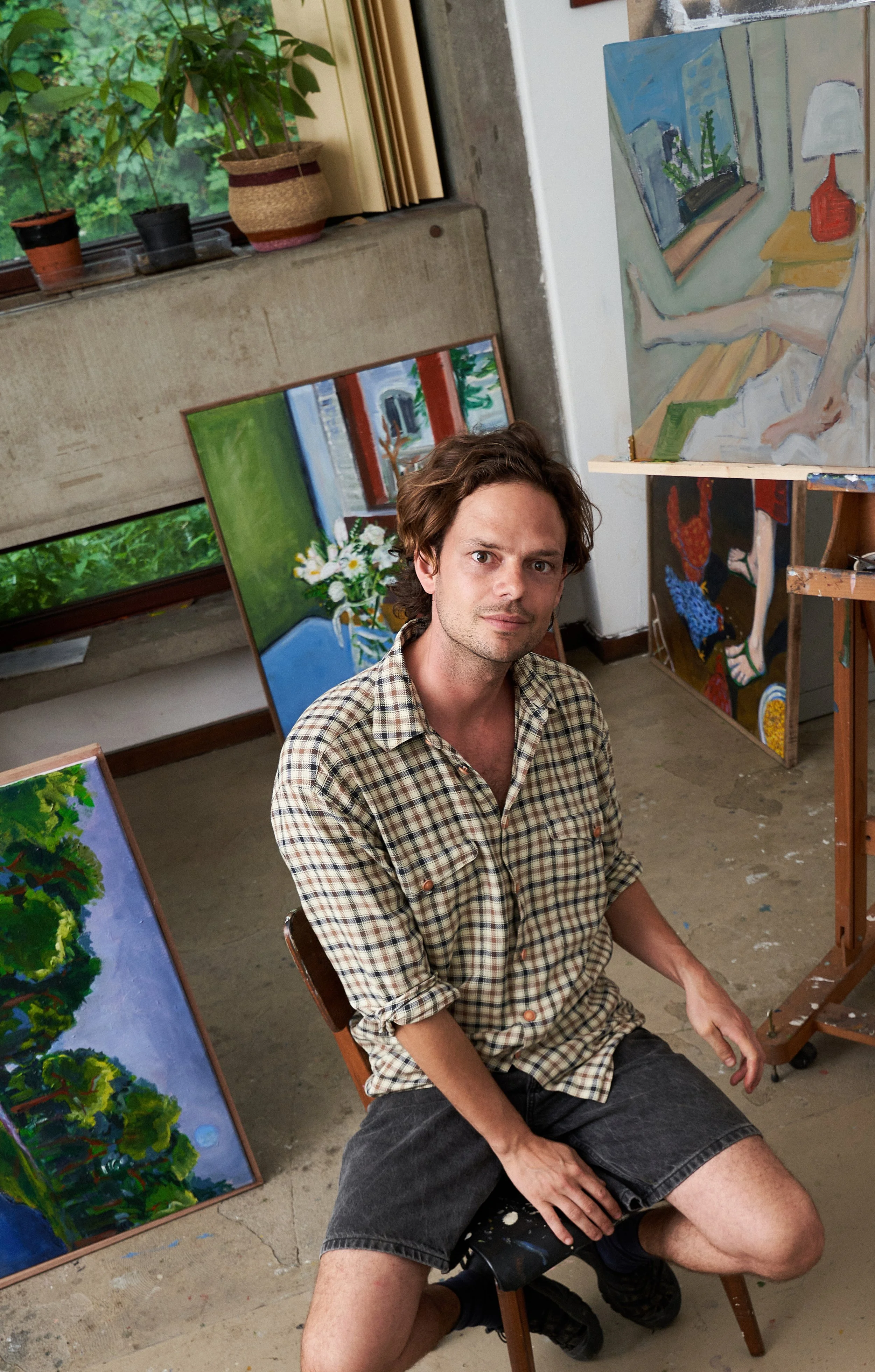
©Thomas Ost
Zeno Aerts was born and raised in Ghent, Belgium (1990). His studies in furniture design took him to Copenhagen in 2010 and later back to Brussels in 2014. His designs are characterised by a colourful interplay of shapes and materials, creating spaces that feel both serene and contemporary.
Drawing has always been at the heart of his creative process, making his transition to painting a natural progression. In 2023, he enrolled at the Sint-Lukas Academy in Brussels to further develop his painting practice.
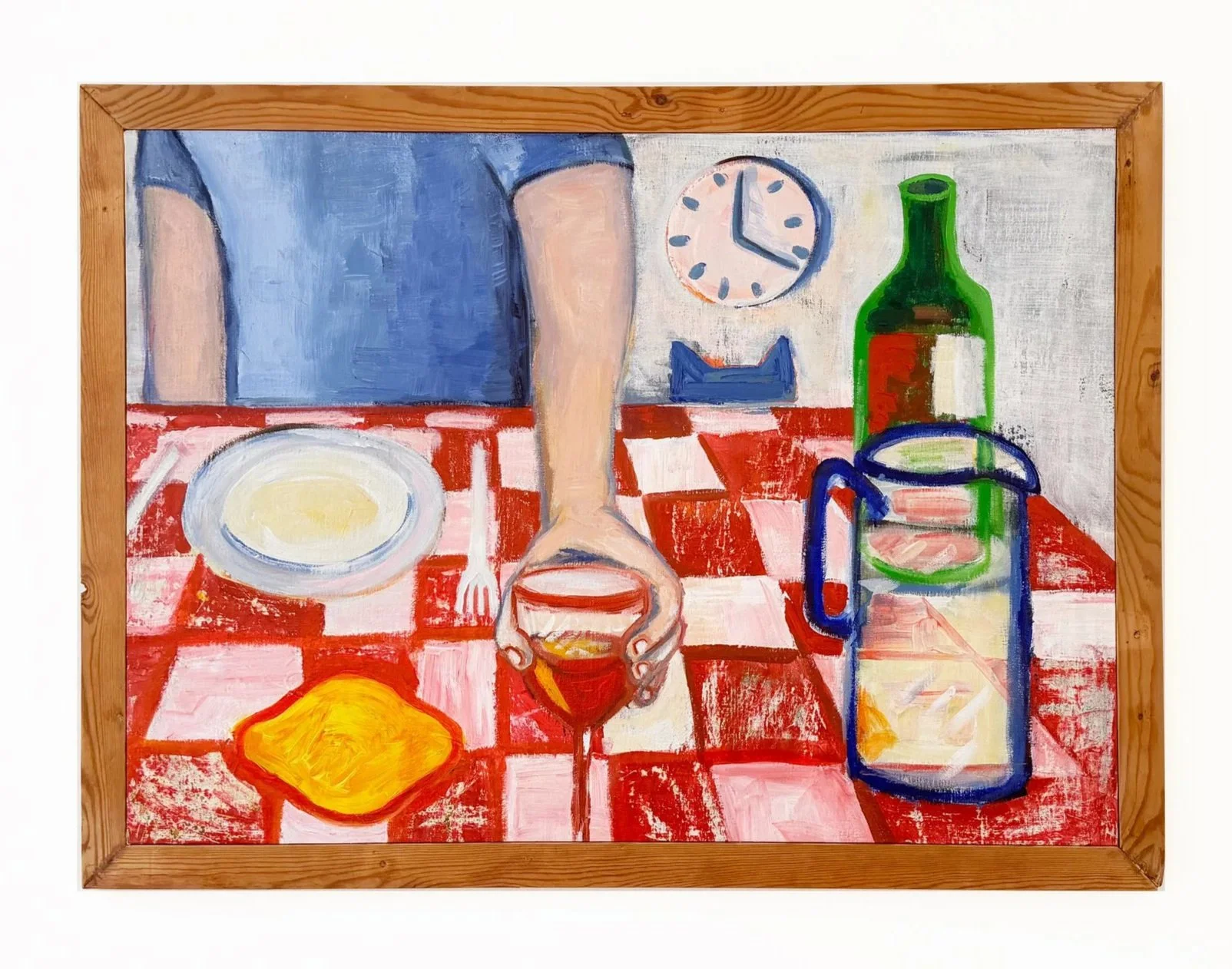
Zeno draws inspiration from Belgian (post-)Expressionist painters such as Jean Brusselmans and Roger Raveel, whose personal lives and immediate surroundings had a direct influence on their work. Similarly, Zeno’s paintings reflect the world around him, filtered through the lens of his own inner experience.
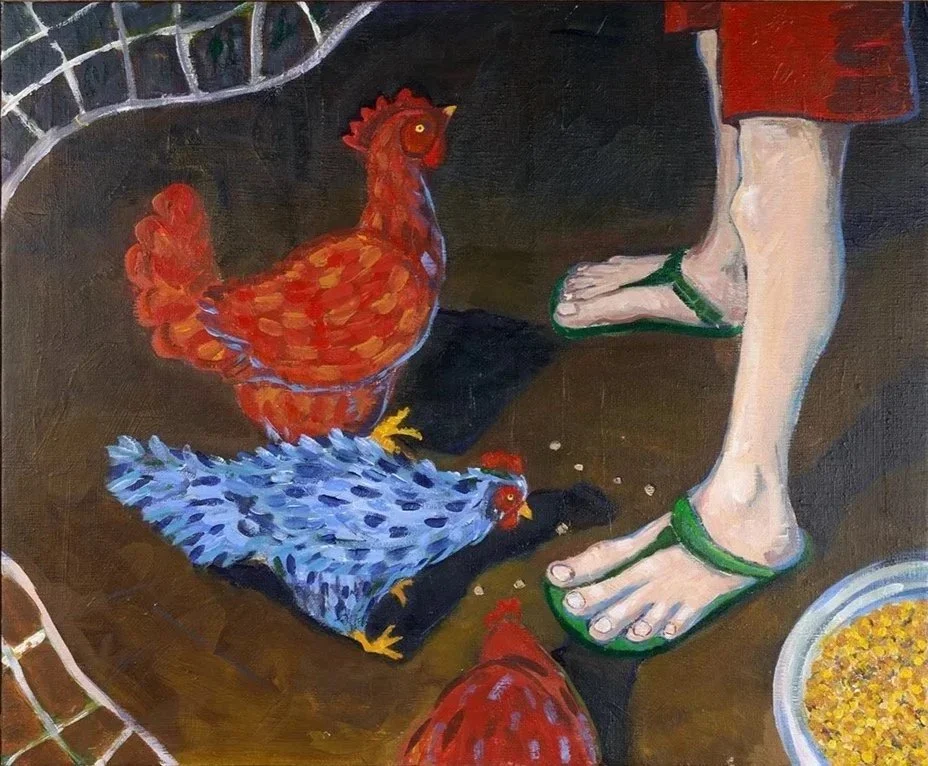
Zeno divides his time between Brussels and the Thiérache region in northern France. For Carhorn Birdsong, he draws on his experiences of these two contrasting worlds. For the first time, around twenty of his works will be brought together and presented at the gallery.
Zeno’s painting style is direct, dynamic and intuitive. Through bold brushstrokes and successive layers of paint, an image gradually takes shape. Using colour and material, he searches for a sense of familiarity and recognition. The strength of his work lies in its emotional truth rather than in a literal interpretation of what is depicted.
The frames featured throughout the exhibition are handmade by the artist himself from pieces of reclaimed wood, further contributing to the unique character of each work.
In the broader context of the exhibition, the bucolic idyll can be seen as a recurring theme throughout Western art history. Artists have long contrasted idealised visions of rural life with the social realities of acceleration and change. Art becomes a subjective means of escape towards “better, more beautiful times”, driven by a longing to reconnect with a simpler way of life. At the same time, these idealised images can act as distorted mirrors, reflecting the social unease of their time.
Today, social media and AI-generated imagery have opened up an entirely new portal for this imagined escape to the countryside. It is against the backdrop of an increasingly technological society that Zeno’s romantic vision of rural life takes shape. In our conversations, he reflects on how we might move towards a society in which biodiversity and natural beauty are given their rightful place — towards an ethical and inclusive environment that acknowledges and respects all forms of life.
His idyll, then, does not lie in a nostalgic past; it is a vision of the future. Perhaps even a utopia. After all, the countryside is as much associated with suburban development, soil pollution, industrial-scale farming and manure surpluses as it is with pastoral beauty.
With Carhorn Birdsong, Zeno creates space for a layered and evolving understanding of what the countryside is — and what it could become.
-
![]()
La Paloma
19,5 × 30,5 cm
Natural pigment and ashes on linen -
![]()
The Dog
20,5 × 30,5 cm
Natural pigment and ashes on linen -
![]()
Ermita de las Nievas around sunset
40 × 30 cm
Natural pigment on linen -
![]()
Los Colores Minerales de Lanzarote
40 × 30 cm
Natural pigment on linen -
![]()
Haria Townhouse
58 × 45,5
Natural pigments on linen -
![]()
Tunanfaya Landscape
58 × 45,5
Natural pigments on linen -
![]()
Viering van het moment
SOLD